Wild Side Seats
Shopify storefront for custom marine-grade Harley seat covers — built, deployed, and kept running.

Alejah Sardiniola
available for work
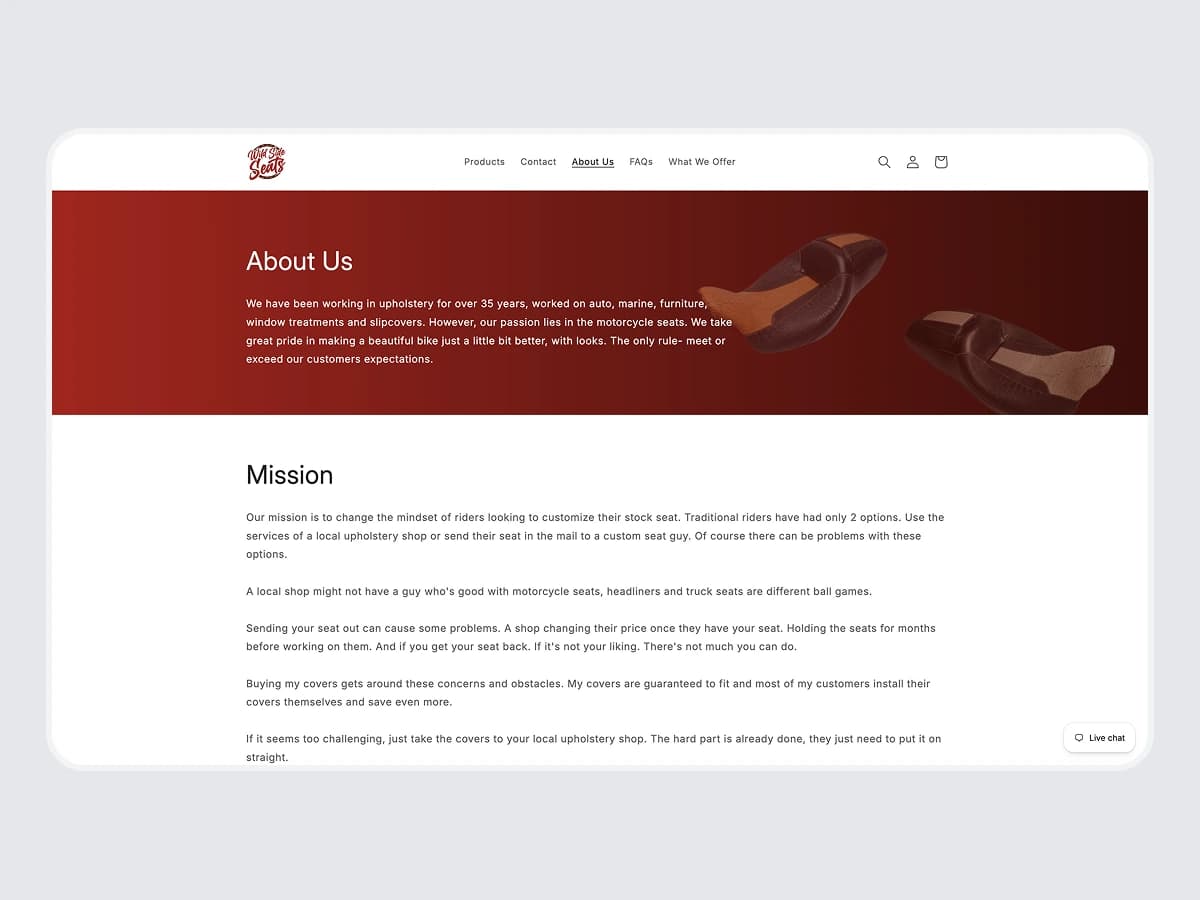
Wild Side Seats sells custom marine-grade vinyl seat covers for Harley-Davidson touring bikes — Street Glide, Road Glide, Electra Glide, Ultra Classic, and the CVO Hammock. Behind the brand is a craftsman with over 35 years of upholstery experience.
My job: make the storefront worthy of the craft. I cleaned every product image, developed and deployed the store on Shopify, made it responsive, and I keep it maintained.
The problem
A 35-year upholstery craftsman doesn't need help making seat covers. He needs help selling them.
That was the gap. Decades of marine-grade vinyl expertise, Harley riders ready to buy — and no storefront doing the work justice.
Here's the thing about e-commerce that most people miss: the product photo is the product. Nobody runs their hand across vinyl through a screen. The image is the only touch they get.
And the raw photos weren't ready to carry that weight.
The solution
I cleaned every product image. Cut backgrounds, corrected color, made the vinyl patterns read true on screen. A rider choosing between colorways needs to trust that what they see is what shows up at their door. That trust is built in pixels.
I developed and deployed the store on Shopify. Collections organized by bike model — because that's how riders shop. Nobody browses “seat covers.” They search their machine.
I made it responsive. Riders aren't browsing at a desk. They're in the garage, phone in one hand, looking at their seat with the other. If the mobile experience stumbles, the sale dies right there.
And I maintain it. New products, seasonal updates, keeping the store fast and live. A storefront isn't a project you finish. It's a machine you keep running.
What was built
- Model-Specific Collections — Street Glide, Road Glide, Electra Glide, Ultra Classic, CVO Hammock. Riders search their machine, not a generic category. The store is organized the way they think.
- Cleaned Product Imagery — Every product photo cut, color-corrected, and made true to the vinyl. What the rider sees on screen is what arrives at their door.
- Responsive Storefront — Built for the garage, not the desk. The store works the same on a phone in one hand as it does on a desktop.
- DIY Install Videos — Step-by-step guides so riders can fit their own covers with confidence, no upholstery shop required.
- Custom Embroidery Orders — Logo and embroidery requests handled through the store, tied straight into the order flow.
Tech stack
Impact
A store where 35 years of craft finally looks like 35 years of craft. Clean product pages, model-specific navigation, DIY install videos, and a checkout that works the same on a phone in the garage as it does on a desktop.
No adaptation tax for the rider. Find your bike, pick your cover, order. Done.
The craftsman makes the covers. The store sells them. Both do their job.
Reflections
E-commerce work is humble work. No novel architecture. No clever engine. Just a craftsman's products, presented honestly, on a store that never gets in the way.
But that's the job. The best storefronts are invisible — the rider remembers the seat cover, not the website. If they noticed the website, something went wrong.
Maintenance taught me the other half of the lesson: a store isn't shipped once. It's kept alive.